
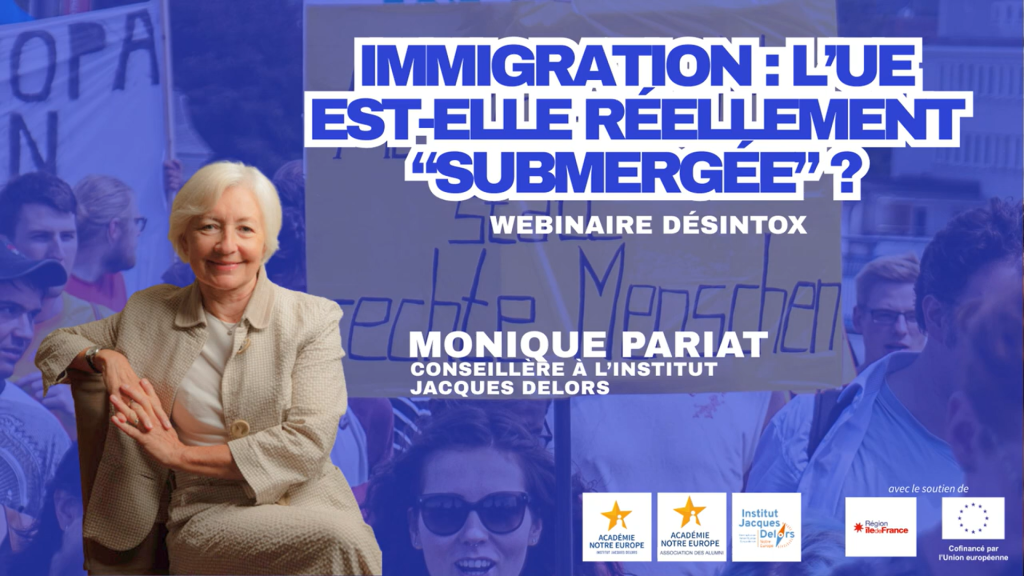
Fact-checking webinar – Immigration: is the EU truly being ‘flooded’? Replay available
In a context where migration is taking up an increasingly prominent place in the European public debate, alarmist perceptions and preconceived ideas sometimes tend to overshadow the facts. Armed conflicts, regional instability, climate disasters, and geopolitical tensions fuel the notion of an uncontrollable migratory pressure on the European Union. But what is the reality? Is Europe today facing a situation of “being overwhelmed”?
With
What the webinar highlighted
First, the data do not support the idea of a Europe overwhelmed by migration. Non-nationals represent around 10% of the European Union’s population, a significant share of whom are intra-European migrants. Moreover, recent flows point rather to stabilisation—or even a decline—in arrivals across several categories, notably asylum applications and irregular entries. At the global level, it is also important to recall that most displaced people are hosted by developing countries, which puts the actual scale of Europe’s reception efforts into perspective.
Second, contrary to widespread perceptions, the vast majority of arrivals in the Union take place through legal channels. In 2024, there were only 178,000 migrants in an irregular situation, representing around 4% of arrivals. These figures show that, contrary to certain narratives, Europe has effective mechanisms in place to frame and regulate the arrival of migrants.
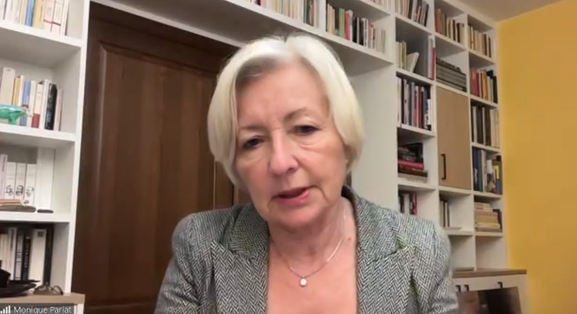
Monique Pariat, Adviser at the Jacques Delors Institute and former Director-General of the Directorate-General for Migration and Home Affairs (DG HOME), we explored three central questions: what are the factual figures regarding migration to the European Union? What are the main challenges facing migration policies today? And finally, what responses are the Union and its Member States providing?
This was a webinar series organised by the Académie Notre Europe and the Académie Notre Europe Alumni Association.
What the webinar highlighted
First, the data do not support the idea of a Europe overwhelmed by migration. Non-nationals represent around 10% of the European Union’s population, a significant share of whom are intra-European migrants. Moreover, recent flows point rather to stabilisation—or even a decline—in arrivals across several categories, notably asylum applications and irregular entries. At the global level, it is also important to recall that most displaced people are hosted by developing countries, which puts the actual scale of Europe’s reception efforts into perspective.
Second, contrary to widespread perceptions, the vast majority of arrivals in the Union take place through legal channels. In 2024, there were only 178,000 migrants in an irregular situation, representing around 4% of arrivals. These figures show that, contrary to certain narratives, Europe has effective mechanisms in place to frame and regulate the arrival of migrants.
Finally, beyond the numbers, the discussion also highlighted the evolution of the European Union’s management capacities. In recent years, Member States and EU institutions have progressively strengthened their tools: the modernisation of Frontex with increased digitisation of border controls, cooperation with neighbouring countries, and enhanced action against smuggling networks. The forthcoming entry into force of the Pact on Migration and Asylum marks an important milestone in this respect, aiming to improve the registration of arrivals, speed up procedures, and better organise solidarity among Member States.
Regrounding the debate in facts
The webinar thus underscored how significant the gap between perceptions and realities remains in the public debate on migration. Amplified by social media and political discourse, certain representations help sustain a sense of permanent crisis that does not always reflect the dynamics observed. Today, migration therefore requires an informed debate, grounded in reliable data and a genuine understanding of the issues at stake.
Projet soutenu par :
- Île-de-France Region

- European Union